


From Guilin to Yangshuo: Karst Peaks, Guanyang Oil Tea & West Street Weekend
Part 3 of 3 – A Recce Tour with Golden Century Tour & Travel Sdn Bhd
Read Part 1 first: From Guilin to Guizhou: An Exploration of Culture, Cuisine & Community at Wujiang Village
Then read Part 2: Exploring Wujiang Village: Guizhou’s Riverside Gem
Our final day in Guilin began bright and early at Floral Eatery, the stylish coffee house of Eeril Hotel (also known as Guilin Huiyu Hotel). With its clean interiors and gentle morning light, it was a pleasant spot for our last breakfast in this part of the city. After a quick meal, bags packed and hearts ready, we checked out and set off to visit one of the most iconic attractions in all of Guilin.

Guilin’s Symbol: Elephant Trunk Hill
They say if you’ve not visited Elephant Trunk Hill, you haven’t truly been to Guilin. And rightly so. This legendary karst formation, shaped like a giant elephant lowering its trunk to sip from the Lijiang River, is not just a natural wonder; it’s the very symbol of the city.


We weren’t alone in thinking so. The area was packed with tourists, all vying for their perfect shot of this scenic spot. Our tour guide, bless her soul, was constantly urging us to move along. There were just too many visitors, and not enough time. Sometimes, we had to queue just to stand in position for a photo, only to be hurried along again.

Still, there was a sense of awe standing there in person. The famed Water Moon Cave beneath the “trunk” shimmered faintly in the river’s gentle flow, creating a quiet pocket of calm amidst the human buzz. Other attractions within this scenic area were the Love Island, Samantabhadra Pagoda, and Sanhua Cellar.

Official photographers were stationed at designated spots, ready to capture your moment with two standard backdrops. Posed, snapped, printed and handed over – for RMB35 a shot. Despite the rush, we got our keepsakes and carried on.
Shanhu Lake’s Twin Pagodas in Daylight
Next on the itinerary was a short walk to Shanhu Lake, where the Sun and Moon Pagodas stood tall side by side. While these twin towers are often praised for their dazzling night-time illumination, we visited during the late morning this time.

Even without the glow of artificial lights, the pagodas were striking in the sun. The Sun Pagoda, covered in shimmering golden tiles, and the Moon Pagoda, cooler in tone with silver hues, both reflected gently on the lake’s placid surface. Against a backdrop of green foliage and clear skies, the architecture stood out beautifully in natural daylight.
Seeing them by day gave us a different kind of appreciation. The intricate details of their design, the reflections on the water, and the surrounding serenity might otherwise be missed amidst the night-time crowd.


Heat, Haste & Heading to Ikigai
By this point, the Guilin sun was blazing down, and we were extremely appreciative for our air-conditioned coach. Summer here can be scorching. Don’t let the romantic karst landscape fool you.
Our next destination has a unique Japanese name: Ikigai.

Pronounced “ee-key-guy”, Ikigai is a Japanese concept that translates to “a reason for being”. It’s about living with purpose, finding joy in small things, and aligning what you love with what the world needs. A fitting philosophy for our stop at the 桂海晴岚国际旅游度假区 (Guihai Qinglan International Tourism Resort).


This newly developed resort area is no ordinary getaway. Surrounded by over 200 karst peaks, it has drawn its name from a classic natural wonder: 桂岭晴岚, one of Guilin’s “Eight Famous Views”. “Guihai” (桂海) refers to the sea of peaks stretching from Guilin to Lingchuan’s Haiyang Township, while “Qinglan” (晴岚) describes the misty purple haze that floats above the mountains after rainfall.
The Yuan dynasty poet Lü Sicheng once wrote: “桂岭崇崇插绛霄, 晴岚浮动翠云飘” — a beautiful depiction of the ethereal fog that hovers over these ridges like something from a dream.


Now developed by Guilin Xinchang Group, the site has been crafted to meet national standards for tourism, ecology and leisure. Already a 4A-rated attraction, it offers everything from mountain-view hotels and day-use restaurants to glamping areas, pet zones, water sports, and off-road ATV trails.

We toured the area via tram and were genuinely impressed by the way nature, culture and comfort had been blended. It wasn’t just scenic; it felt intentional. A place built for contemplation as much as recreation.


The Bold Flavours of Oil Tea
Lunchtime brought us to a charming eatery called Feiyiyoucha Daiguike, located in Guilin’s Qixing District. It looked ancient from the outside with aged wood, imperial roof and traditional signboard. Well, you can’t miss it. The star of the menu? Guanyang Oil Tea (灌阳油茶), also fondly known as “Chinese coffee”.


Here’s how it works:
First, tea leaves are boiled with ginger, garlic, green onions and salt. The brew is enhanced with oil (traditionally lard or peanut oil) and poured over a mixture of fried rice, peanuts, salty pork ribs, mushrooms and vegetables. The result is a rich, savoury drink that’s not quite like soup or tea.

Guanyang-style is said to be milder and less bitter than the more popular Gongcheng version, and that’s what we tasted: bold but balanced. Before the main tea, we were served a sweet “sugar tea” to whet the appetite. It’s part of the ritual and considered rude to skip in traditional Guanyang hospitality.


The locals may take it daily, but it’s an acquired taste. That said, I could definitely see why it’s dubbed “Chinese coffee”- it perked us right up! We also had an excellent crispy duck and a flavourful claypot swordfish. It was a meal that lingered long after we left.
Want to know what goes into Oil Tea? Take a look at this photo we snapped of Tianxi Guanyang Mama Oil Tea (天禧灌阳妈妈油茶). It says it all!

A Quick Stop for Monk Fruit
Our journey continued with a brief detour to Wulidian Fruit & Vegetable Wholesale Market (五里店果蔬批发市场) as some of our tour mates wanted to pick up some sweet Luo Han Guo (罗汉果 / Monk Fruit).


We were advised to buy the golden-coloured ones, which are more expensive but considered superior. These are processed using a low-temperature vacuum dehydration method, preserving their nutrients and subtle fragrance. The darker ones, on the other hand, are roasted using traditional high heat, resulting in a deeper, smokier flavour with less freshness.

Armed with this knowledge, we made our selections and were quickly back on the road to Yangshuo.
Yangshuo West Street Weekend Vibes
After a 1.5 hour trip, we checked into Yangshuo New West Street Hotel (also Grand Rezen Hotel Yangshuo), strategically located just steps from West Street, the beating heart of Yangshuo. On weekends, the place transforms into a buzzing hive of food stalls, street performers, and souvenir shops lit by lanterns and neon signs.


Dinner was right next door at 大师傅啤酒鱼 (Master Beer Fish) on Pantao Road. The restaurant was packed, and for good reason. Their beer fish was tangy, aromatic, and absolutely moreish. We later spotted two other outlets of the same name just along West Street. Clearly, it’s a local hit.


The Ancient Charm of West Street
In the heart of Yangshuo County lies West Street (阳朔西街). This is a storied thoroughfare with over 1,400 years of history, yet still brimming with youthful energy. Paved in smooth marble and tracing an elegant S-shaped curve through town, this 8-metre-wide street that stretches up to 800 metres in length, has become a cultural melting pot unlike any other in China.

Affectionately dubbed “Global Village” and “Foreigners’ Street”, it welcomes more than 100,000 international visitors annually. In fact, there are moments when foreigners outnumber the locals, creating a truly cosmopolitan atmosphere amid traditional Chinese surroundings.


What makes West Street so enchanting is not only due to its well-preserved Ming and Qing dynasty architecture with intricate wooden facades, grey-tiled roofs and leafy courtyards, but also its unique fusion of heritage and modernity.


Surprisingly, the street has over 20 foreign-owned businesses, ranging from European-style cafés to tattoo studios and kung fu schools, standing side-by-side with stalls selling calligraphy scrolls, embroidered silk fans, and wax-dyed handicrafts.


A visit to West Street in broad daylight and after sunset offers two different vibes. At night, West Street offers a kaleidoscope of lights, music and energy, with bars, street performers and open-air concerts drawing in lively audiences.

The crowd on West Street that Saturday night was intense – much livelier than Guilin’s Zhengyang Road Pedestrian Street. We were also advised to be mindful of pickpockets. SWAT officers and K9 patrols were visible, ensuring order.

Prices of accessories like earrings and dresses seemed to drop as the clock ticked closer to midnight. We couldn’t help but stay out till late into the night, shopping, snacking, and soaking it all in.

A Rainy Send-off & Final Flavours
Day 6 started with rain, but by breakfast, the sky had cleared. The hotel’s buffet included local favourites like black rice porridge, soup noodles and black soy drink, all healthy and comforting.


Since it was Sunday, we strolled across to Yangshuo Park, just opposite our hotel. Tourists tried their hand at tai chi while locals danced or jogged. It was a wholesome way to start the day.


Before long, we had checked out and were back on the road.
First stop: Shangyue Scenic Area (赏月景区). We managed to snap plenty of photos of the unique moon-shaped hole in the mountain just before another downpour began. Lucky us!


Our next stop was to Yulong River Bridge, where we saw tourists on bamboo rafts gliding along the calm water. It looked like great fun. Maybe next time?


Final Meal & Fond Farewell
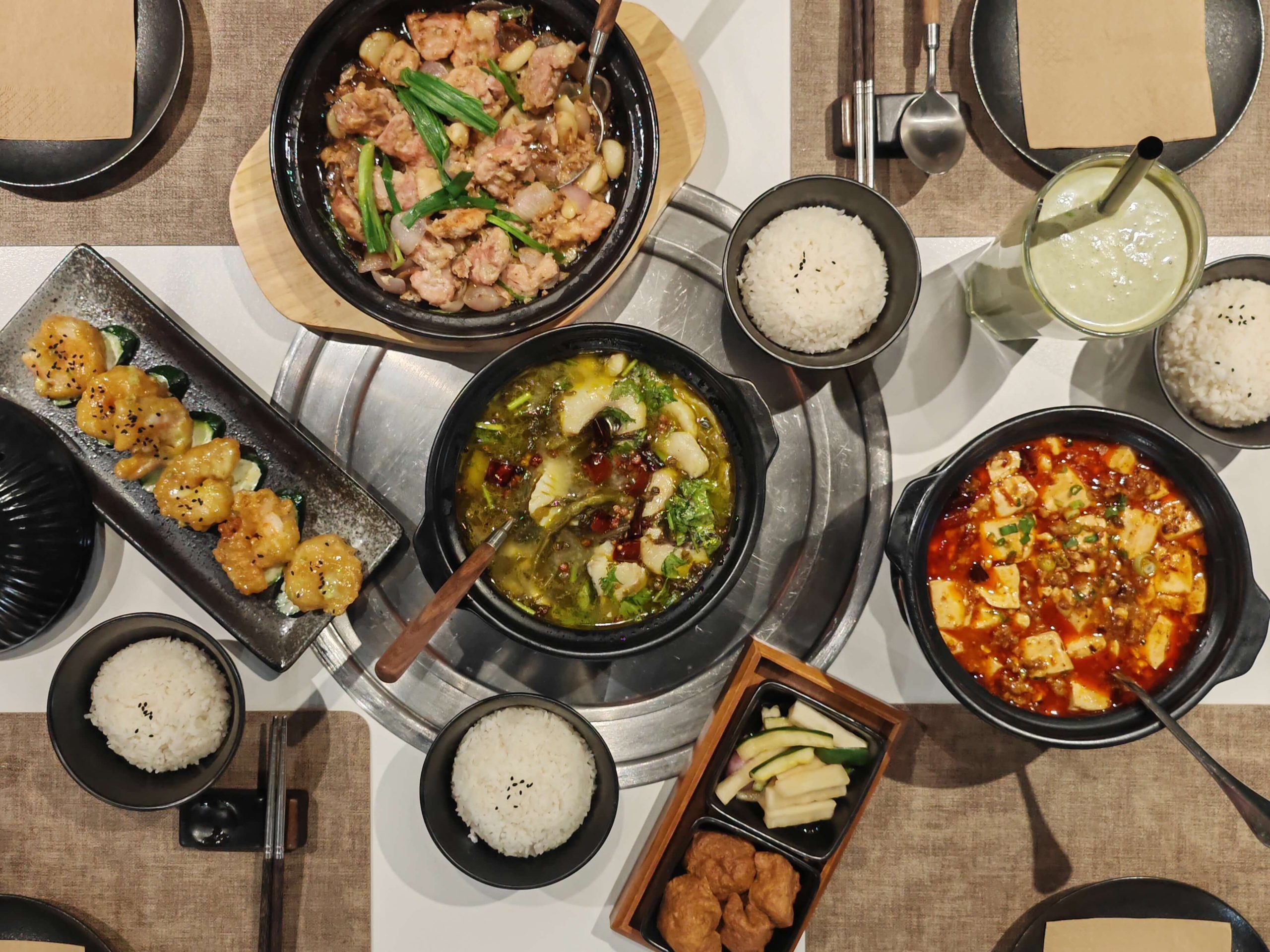
Lunch was at 万江私房菜馆, a private restaurant in Yangshuo. The highlight? A bubbling hotpot with a variety of ingredients but our personal favourites were the large, juicy mushrooms and a perfectly cooked sweet-and-sour fish. Honestly, every meal served on this tour was yummilicious.


Outside, a street vendor hawked dried longan, mushrooms, nuts, and more. With our last few yuan, we picked up some final goodies and boarded our coach to Guilin Liangjiang International Airport.

Unfortunately, a system issue caused some delay, and our 4pm Batik Air flight was pushed back by half an hour. But all was smooth in the end, and we landed safely at KLIA Main Terminal (KLIA1) in good time. When we reached Ipoh, it was already past 1am. Exhausted but filled with incredible memories.

This six-day adventure from Guilin to Wujiang to Yangshuo was a feast for all senses. The sceneries stunned, the yummy food delighted, and the cultural richness made every stop meaningful.

Read Part 2 (Days 3 & 4): Exploring Wujiang Village: Guizhou’s Riverside Gem
This exploration was made possible by the kind invitation of Golden Century Tour & Travel Sdn. Bhd. EMILY2U MEDIA would like to formally express their greatest appreciation to Golden Century Tour boss, Mr Jimmy Goh and his team for their hospitality.